WhatsApp: +91 99986-85666
|
🚀 Welcome to FiberValley Communications Pvt Ltd – Fast • Reliable • Affordable Internet Plans!
|
⭐ Exclusive Offers Available Now!
|
WhatsApp: +91 99986-85666
|
🚀 Welcome to FiberValley Communications Pvt Ltd – Fast • Reliable • Affordable Internet Plans!
|
⭐ Exclusive Offers Available Now!
|
What is FTTH and Why It Matters
What is FTTH, and why does it matter for your home internet in Surat? If you have been comparing broadband plans recently, you have probably seen this term without a clear explanation of what makes it different from a regular connection. This guide answers that in plain language. By the end, you will understand exactly what FTTH means, how it works, why it performs better than older broadband technologies, and whether it makes sense for your home or business in Surat.
What FTTH Means in Simple Terms
FTTH stands for Fiber To The Home. It means that a fiber optic cable runs directly from your internet service provider’s network all the way into your home, not just to a cabinet on the street or a box in your building. It runs all the way to your actual premises.
This is important because the last stretch of the connection, called the last mile. is where most internet problems happen. Older broadband technologies use fiber cables for most of the journey but switch to copper wire for this final stretch. That copper section degrades the signal, reduces speed and creates instability.
With FTTH, there is no copper involved at all. The fiber optic cable carries data as pulses of light from the provider’s network directly to a small device installed at your home called an ONT, which stands for Optical Network Terminal. Your router connects to this ONT and distributes the connection to all your devices via WiFi or ethernet.
In simple terms, FTTH removes the weakest part of a traditional broadband connection and replaces it with the strongest, fiber all the way to your door.
How FTTH Is Different from Cable and Copper Broadband
Understanding what FTTH is becomes clearer when you compare it to the alternatives available in Surat.
Traditional cable broadband uses a hybrid setup, fiber cables carry data from the provider’s central office to a neighbourhood cabinet, then copper or coaxial cable carries it the final distance to your home. That final copper stretch degrades with distance and is shared among multiple homes. The more neighbours using it simultaneously, the slower everyone’s connection gets.
Mobile broadband and hotspots use cellular towers rather than physical cables. Speed and reliability depend entirely on tower proximity, congestion, and physical obstacles. In dense areas of Surat like Citylight or Adajan, signal quality can vary significantly from floor to floor in the same building.
FTTH fiber broadband eliminates the copper last mile entirely. Each home gets a dedicated fiber path. Your speed does not degrade based on how far you are from the cabinet or how many neighbours are online. According to TRAI’s Indian Telecom Services Performance Indicators Report 2023-24, fixed broadband subscribers in India grew significantly in 2023-24, with FTTH-based connections driving the majority of new additions as users shifted away from older copper infrastructure.
How an FTTH Connection Actually Works at Your Home
Many people understand what FTTH means in theory but are unsure what the installation actually involves. Here is the process in straightforward terms.
The Fiber Cable
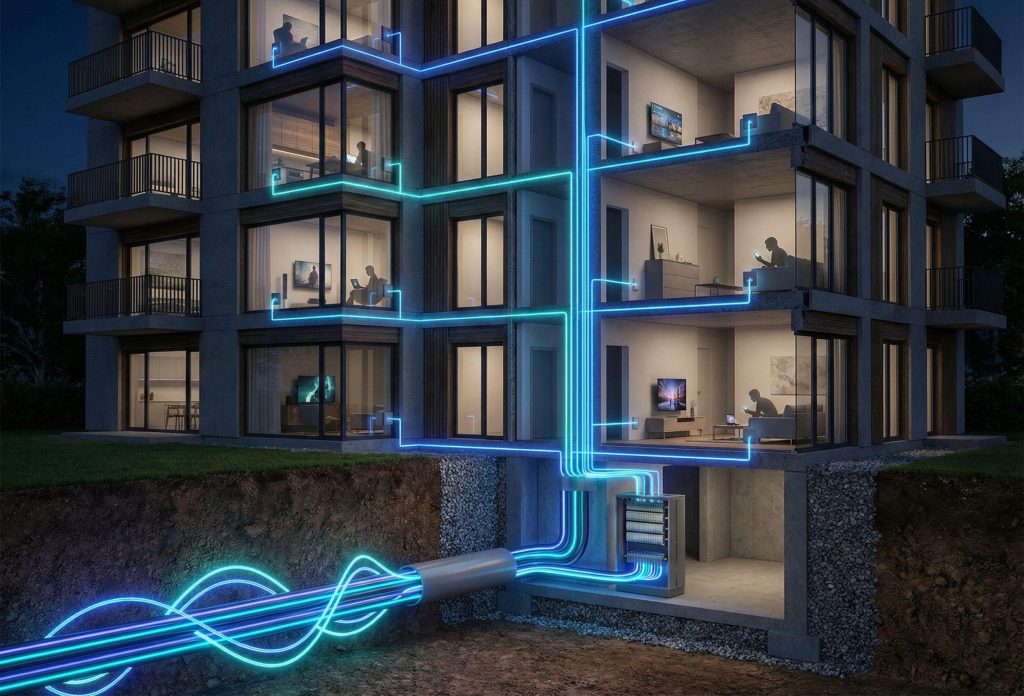
A thin fiber optic cable , roughly the diameter of a human hair, runs from the provider’s nearest distribution point to your building. In apartment complexes in Surat, this cable typically runs through existing conduit or is laid along the building’s exterior to reach your floor.
The ONT Box
At your home, the fiber cable connects to a small white box called an ONT, which stands for Optical Network Terminal. This device converts the light signals carried by the fiber into a format your router can use. Most ONT boxes are about the size of a small book and are usually mounted on a wall near your main entry point.
Your Router and WiFi
Your router connects to the ONT using a standard ethernet cable. From there, your home WiFi network works exactly as it would with any other broadband connection. The difference is that the signal feeding your router is significantly faster and more stable than what copper-based connections deliver.
The full installation at a typical Surat home takes two to four hours and requires no major construction work. Your existing router can usually be kept, though a newer router is recommended to take full advantage of higher fiber speeds.
What Is FTTH Good For, Real Usage Scenarios in Surat
Knowing what FTTH is matters less than understanding what it actually changes about your daily internet experience. Here is how it makes a difference in real Surat households.
Families with Multiple Devices
A typical Surat family home today has 6 to 10 connected devices, smartphones, smart TVs, laptops, tablets and streaming devices. On a cable connection, each additional device reduces the available bandwidth for everyone else. On an FTTH connection, the dedicated fiber path means the total bandwidth is not shared with neighbours, giving each device in your home more consistent speed.
Work From Home Professionals
Upload speed is where FTTH makes the most visible difference for professionals. Video calls, cloud file transfers and screen sharing all require strong upload performance. FTTH plans typically offer symmetric or near-symmetric speeds , meaning upload and download speeds are similar, which is far better than cable plans that often give fast downloads but slow uploads.
Students and Online Classes
Online classes require a stable, low-latency connection more than raw speed. A dropped connection mid-class or buffering during a live lecture is far more disruptive than simply having lower speeds. FTTH’s dedicated path and consistent latency make it significantly more reliable for sustained online learning sessions.
Small Businesses in Surat
Retail shops, diamond industry offices and textile businesses in Surat increasingly depend on cloud software, digital payment systems and video communication. FTTH delivers the reliability these operations need . Most FTTH providers also offer business plans with uptime guarantees that cable broadband cannot match.
You can compare Fibervalley FTTH fiber plans available in Surat to see which option fits your household or business requirements.
Why FTTH Performs Better During Peak Hours and Bad Weather
This is the aspect of FTTH that most technical articles miss, and it is the most practically important for Surat residents.
Peak Hour Performance
Between 8pm and 11pm, internet usage across Surat peaks as families stream, game and video call simultaneously. On shared cable networks, this congestion causes speeds to drop noticeably. On FTTH, each home has a dedicated fiber path, which means your connection is not affected by what your neighbours are doing online. According to Opensignal’s India Fixed Broadband Experience Report for Gujarat, FTTH regional operators in Gujarat consistently outperform cable-based providers on speed and connection consistency metrics.
Monsoon and Summer Heat
Surat’s climate creates specific challenges for cable-based internet. Copper wires conduct electricity, which means they are susceptible to moisture ingress during heavy monsoon rains and to electrical interference during thunderstorms. Summer heat above 40 degrees Celsius also accelerates the degradation of copper connections over time.
Fiber optic cables carry light, not electricity. They are completely unaffected by moisture, heat or electrical interference. This is why Surat residents on FTTH connections typically notice that their internet remains stable throughout monsoon season while cable users in the same area experience frequent drops.
Is FTTH the Same as Fiber Broadband?
This is a common point of confusion. The terms are related but not identical.
Fiber broadband is a broad term for any broadband connection that uses fiber optic cables somewhere in its network. This includes connections where fiber runs only to a street cabinet with copper wire completing the final stretch to your home . This setup is called FTTC, or Fiber To The Cabinet.
FTTH specifically means the fiber runs all the way to your home with no copper involved. It is the highest standard of fiber broadband delivery.
When a provider advertises fiber broadband without specifying FTTH, it is worth asking exactly where the fiber ends. If the answer is ‘at the building’ or ‘at the cabinet,’ the connection you receive may not deliver the same performance as a true FTTH connection.
Fibervalley’s network in Surat is built on genuine FTTH infrastructure . The fiber cable reaches directly to each home rather than stopping at a shared point. If you want to verify availability at your address, you can get FTTH fiber internet installed at your home in Surat by contacting our team directly.
What to Expect When Getting FTTH Installed in Surat
If you are considering switching to FTTH, here is what the process typically involves in Surat.
- The provider checks whether fiber infrastructure has already been laid in your area or building
- A technician visits your home to run the fiber cable from the building entry point to your preferred router location and install the ONT box
- The connection is tested and activated, typically on the same day as installation
Documents usually required include a photo ID and address proof. Installation timelines in Surat typically range from same-day to three working days depending on area and provider availability.
If you experience any connection issues after installation, the guide on fixing common internet connection problems in Surat covers the most common causes and solutions.
Frequently Asked Questions
What is FTTH internet and how is it different from normal broadband?
FTTH stands for Fiber To The Home and means a fiber optic cable runs directly from your provider’s network into your home with no copper wire involved. Normal broadband often uses copper for the final stretch between a street cabinet and your home, which limits speed and reliability. FTTH removes that copper section entirely, delivering faster and more consistent internet.
Is FTTH available in Surat?
Yes. FTTH infrastructure has been deployed across many residential and commercial areas in Surat. Availability depends on whether fiber has been laid in your specific building or street. Contact your preferred ISP to check availability at your exact address.
What is the ONT box installed during FTTH setup?
The ONT, which stands for Optical Network Terminal, is a small device installed at your home that converts the light signals from the fiber optic cable into a format your router can use. It is roughly the size of a small book, is usually wall-mounted, and requires a power connection. Your router connects to it via a standard ethernet cable.
Does FTTH work better during rain and summer in Surat?
Yes. Fiber optic cables carry light rather than electrical signals, so they are completely unaffected by moisture, heat, or electrical interference. This makes FTTH significantly more reliable than copper-based connections during Surat’s monsoon season and extreme summer heat.
How long does FTTH installation take in Surat?
Installation typically takes two to four hours for a standard home. If fiber infrastructure is already present in your building, the process is faster. Most providers complete installation within one to three working days of the request being confirmed.